

The Master of Biomedical Innovation (MBI) program is a multidisciplinary, project-oriented, professional graduate program focused on bridging the gap between health technology development and its transfer to biomedical markets. Graduates with the MBI degree will have the knowledge and skills needed to seamlessly foster innovative biomedical approaches to current and future health challenges.
The MBI program is a full-time, in-person graduate program with a project and course-based curriculum. The program commences with an opening bootcamp and clinically immersive experience, guiding learners through the need-finding and biomedical innovation process. Learners apply theories and entrepreneurship competencies acquired throughout the program to a venture-oriented project. Whether a recent graduate, or a seasoned professional wanting to break into a new industry, the MBI provides a unique opportunity to pursue innovation and entrepreneurship to impact health care.
Develop a venture-oriented project using a needs-driven approach and entrepreneurial mindset.
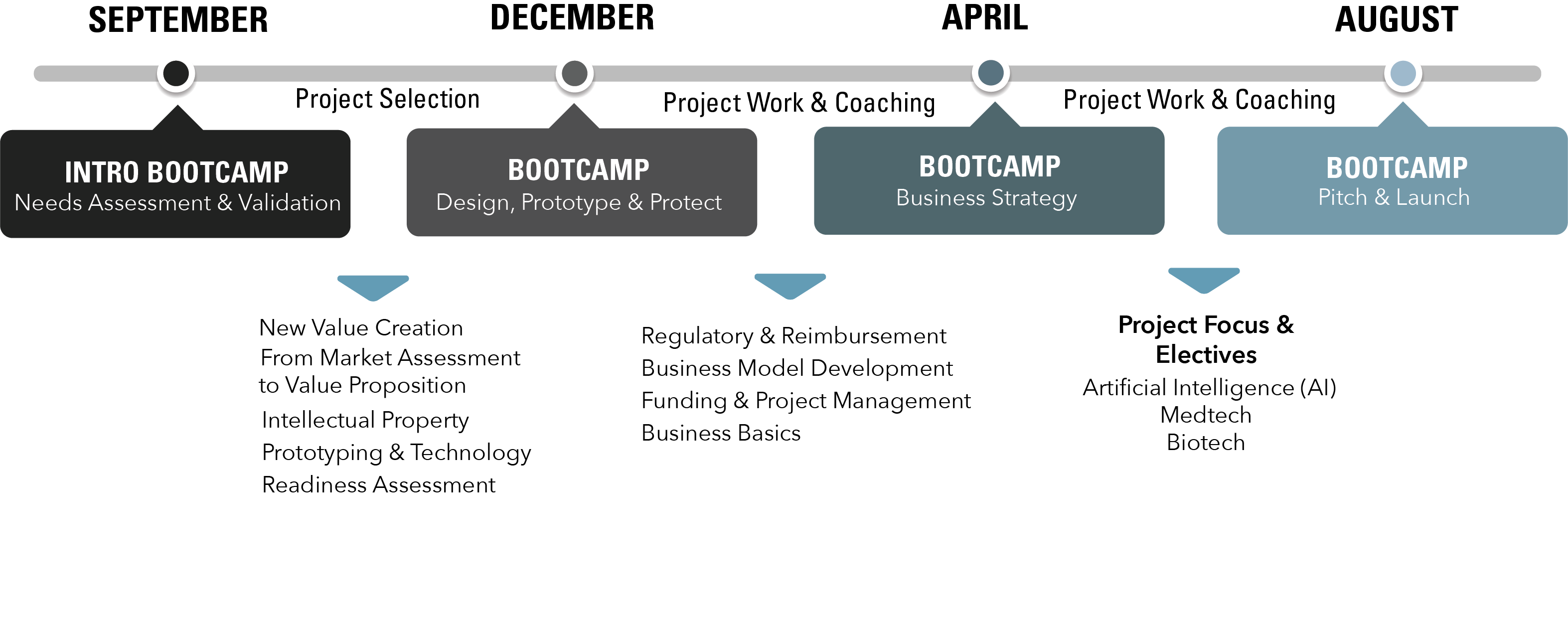
MBI CURRICULUM AT A GLANCE

Expandable List
The cohort will be brought together in-person for a week-long bootcamp*, during which students will become oriented to needs-driven innovation through a clinical immersion experience.
*Bootcamp dates will be communicated to each cohort by the MBI program administrator.
The clinical immersion experience will afford an opportunity for student groups to visit clinical areas within local hospitals. This clinical experience will be focused on needs-finding through a process of observation and dialogue with healthcare practitioners to provide an understanding of the clinical environment, where students will identify and validate a healthcare problem in order to create a potential innovation project.
This multi-term project-based course provides students the opportunity to apply concepts from core courses and academic development forums to their innovation project for the duration of the program. Students will be evaluated on the completion of a set of milestones that focus on establishing the desirability, feasibility and viability of their innovation.
All students will have access to mentors and advisors who will help guide them throughout the entirety of the project.
BIOMEDIN 701 a,b,c: Concept Generation (1.5 units)
This concept generation course offers dedicated time for students to translate unmet needs observed during the clinical immersion experience into viable solution concepts through a structured, iterative process. The course emphasizes creativity, critical thinking, and user-centered design to develop early-stage ideas that are both technically feasible and clinically relevant. Students will explore methods such as brainstorming, needs validation and stakeholder interviews to evaluate and refine potential solutions for a project.
BIOMEDIN 704: New Value Creation (1.5 units)
This course is designed to allow students to identify unmet needs, identify potential root causes of observed problem(s), and validate them. Students will also learn how the healthcare system functions so that they can identify important stakeholders in the healthcare space. They will practice ideation methods to develop the framework for potential solutions that address unmet needs within the confines of complex healthcare systems.
BIOMEDIN 705: From Market Assessment to Value Proposition (1.5 units)
In this course, students will learn to assess whether there are available alternatives already on the market that solve the identified problem and estimate market size, including dollar size and number of users. They will identify potential barriers to market entry and strategies to overcome them. They will validate the product-market fit for the proposed problem solution (innovation), identify risks and risk mitigation strategies in alignment with industry standards, and learn how to articulate a competitive advantage for their proposed solution.
BIOMEDIN 706: Intellectual Property (1.5 units)
This course will cover how to conduct patent searches and how intellectual property (IP) can be protected in a variety of innovation domains, including medical device, therapeutics and diagnostics, and digital health. Students will learn how to maintain confidentiality in external-facing communications and how to develop and execute an IP strategy.
BIOMEDIN 707: Prototyping and Technology Readiness Assessment (1.5 units)
This course will guide students through topics such as design thinking, proof of concept, and rapid prototyping alongside health professionals and users in both simulated and operational environments. Students will gain the knowledge and skills required to prototype various health innovations including digital health, therapeutics, diagnostics, and medical devices. The students will also learn how to integrate design factors into their prototypes and successfully test new prototype iterations in real-world environments to prepare for full-scale implementation.
BIOMEDIN 708: Regulatory and Reimbursement (1.5 units)
This course explores the regulation and reimbursement landscape in biomedical innovation. Students will gain an understanding of the regulatory frameworks governing the development and approval of medical products, including drugs, devices, and diagnostics. Practical skills will be developed in ensuring compliance with regulatory requirements and ethical considerations. Students will learn to navigate the complex reimbursement systems, analyze reimbursement models, and evaluate the implications for biomedical innovations.
BIOMEDIN 709: Business Model Development (1.5 units)
This course explores the key components necessary for success in the biomedical industry. Through a combination of theoretical knowledge and practical application, students will learn to identify and analyse the critical elements of a business model specific to biomedical innovations. They will learn how to evaluate and determine the most appropriate business model for viability and revenue generation that aligns a biomedical innovation with a target market, maximizes value creation and ensures long-term sustainability.
BIOMEDIN 710: Funding and Venture Creation (1.5 units)
This course explores funding and venture creation for new startups. Students will gain an understanding of various funding sources available to startups, including venture capital, angel investors, crowdfunding, and government grants. They will learn to develop an effective funding strategy and navigate the negotiation process when securing funding. Students will also gain insight into how biomedical ventures are established, nurtured, and scaled. How raised funds are used for growth of the new venture, how people are hired and retained, and what is needed to ensure the stability of a new venture.
BIOMEDIN 711: Business Basics | Principles for Pragmatic Entrepreneurship (1.5 units)
This course provides an introduction to the essentials of running and managing a startup company. Students will develop skills in strategic planning, and business development to drive growth and market success. Students will evaluate tools for financial planning, budgeting, and forecasting to make informed business decisions. This course will also focus on effective leadership and team management, including managing conflicts and challenges, building company culture, as well as human resources management.
Students will take a minimum of two 1.5-unit electives based on project focus including topics such as Artificial Intelligence in the biomedical sector, complexity in healthcare and adaptive systems, and preparing for due diligence.
BIOMEDIN 712: Artificial Intelligence in Healthcare: Foundations & Applications (1.5 units)
This elective course will provide students with a foundational knowledge of a number of AI topics in healthcare, including the basics of AI, Machine Learning, Deep Learning, Convolutional Neural Networks, AI applications in medical imaging (classification, detection and segmentation) incorporating methods from natural language processing and the use of AI in new drug discovery.
BIOMEDIN 713: Navigating Complexity: Implementing Innovation in Healthcare (1.5 mins)
This elective course introduces entrepreneurship students to complexity theory through a healthcare lens. Successful innovation is not just about creating a ground-breaking technology. Up to 90% of innovations in healthcare ultimately fail due to improper implementation and change management strategies. This course helps learners students gain a deeper appreciation of how to bring a new technology into a healthcare setting successfully, using case studies, projects, and discussions that illustrate common leadership, innovation and management challenges and how to overcome them.
BIOMEDIN 714: Preparing for Due Diligence (1.5 units)
This elective course is designed to equip innovators with comprehensive knowledge of the due diligence process, a crucial step towards securing strategic partnerships. Often, innovator companies miss the chance for strategic alliances due to unfamiliarity with due diligence and insufficient preparation. By the end of this course, participants will be well-versed in all facets of due diligence, ensuring they are thoroughly prepared to engage effectively in the process and successfully secure strategic partnerships.
Academic Development Forums (ADFs) provide dedicated time for students to engage in meaningful dialogue, skill-building, and professional growth beyond the traditional classroom. These forums delve into topics central to academic and career development such as critical thinking, communication, leadership, and collaboration and are designed to deepen understanding of key concepts aligned with the MBI curriculum. Led by faculty, industry leaders, and guest speakers, ADFs may take the form of workshops, fireside chats, case-based discussions, or collaborative problem-solving activities. Together, these sessions will enrich the academic journey and help prepare students for real-world innovation and entrepreneurship.
The final pitch marks the culmination of the MBI program, where students integrate everything they have learned into a compelling pitch presentation. The final pitch challenges innovation teams to present their venture project to a panel of industry experts where each team showcases the depth of their understanding, the strength of their business model, and the potential real-world impact of their biomedical solution. The top three teams will be awarded prize money to support the continued development of their innovation beyond the program.
MBI TESTIMONIALS
GRADUATE OPPORTUNITIES
Graduates of the MBI program will have the knowledge and skills needed to seamlessly foster innovative biomedical approaches to current and future health challenges from the earliest stage into practical, market-ready ventures. MBI graduates will contribute to the growing biomedical and health technology sector, thereby attracting and retaining entrepreneurial talent that leads to the creation not only of improved health care, but new jobs, economic growth, and community benefits.
By the end of the program, graduates will have gone through the full cycle of creating a business product. With the personalized support of coaches and mentors, graduates will have learned the skills, and acquired the network and expertise in the healthcare space to be a successful innovator and disruptor in the healthcare arena.
Graduates of the MBI program will be able to:
- Become a founder of a health-focused startup company
- Spin out a new health technology from their academic research or clinical area
- Advance the innovation agenda of an existing health-focused company or organization
- Work for an emerging health or medical technology company
- Leverage the entrepreneurial knowledge and skills acquired in the MBI that are required to transition into a leadership position in various industries